


The Problem With Managing Hotel Revenue Across Five Different Dashboards

It is Monday morning and the general manager wants one answer: how did last week go, and what do we change?
To answer it, someone opens five tabs. The PMS. The rate shopping tool. Google Analytics. Google Ads. Meta. Four of them show a revenue figure, and none of the four match. The fifth shows the market moving underneath all of them.
Nobody has made a mistake. Each dashboard is correct by its own rules. The problem is that the rules are different, and the hotel is trying to run one business on five sets of them.
Each tool was built to answer one question well. Trouble starts when a hotel asks it a different one.
Only the PMS records money a guest actually paid. Every other figure is an estimate, a forecast or a claim.
Take one ordinary booking. A guest books on 3 November for a stay on 20 December, after seeing an Instagram ad and later clicking a Google search ad.
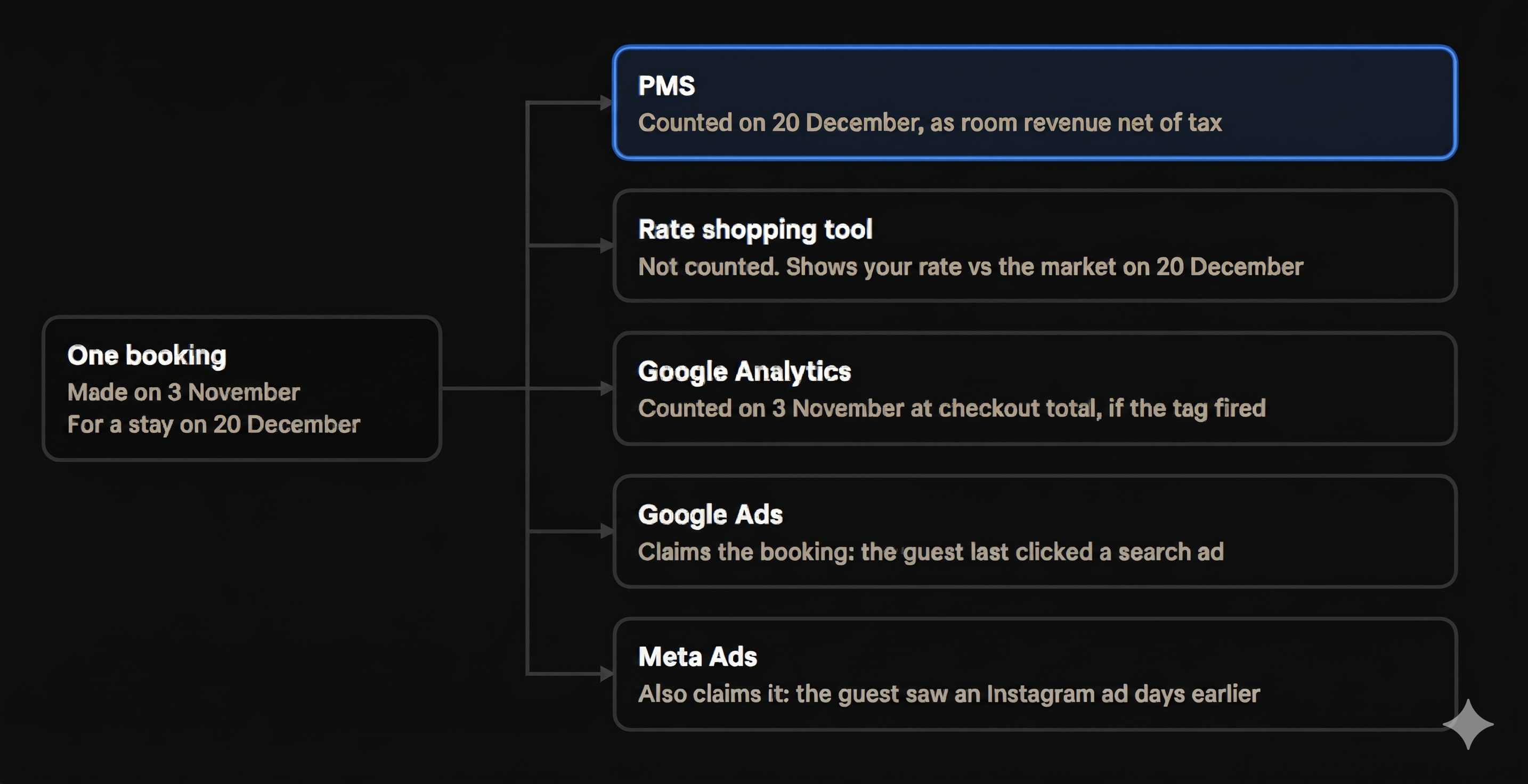
One booking lands in two different months, is counted at two different values, and is claimed twice by paid media. Only the highlighted reading is money the hotel actually received.
Different dates. The PMS and the revenue team count a booking on the night the guest stays. Google Analytics and the ad platforms count it on the day it was booked. A December stay booked in November lands in two different months, depending on which screen you read.
Different definitions of revenue. The PMS may report room revenue net of tax and after cancellations. The booking engine passes GA4 the total the guest saw at checkout, often including tax and sometimes extras. A cancelled booking stays in GA4 and the ad platforms unless someone removes it.
Every ad platform claims the booking. Google Ads credits the booking to the last ad clicked. Meta may credit the same booking to an ad the guest saw days earlier. Add the two together and paid media appears to have produced more bookings than the hotel took.
Different currencies. An ad account can bill in US dollars while the hotel sells rooms in rupees, and a GA4 property has its own currency setting. A return-on-spend figure that divides one currency by another without saying so is wrong by the exchange rate.
Different timing. Each tool refreshes on its own schedule and in its own time zone. Ad platforms keep adding late conversions for days. A figure read on Monday can be different on Thursday without anything having happened.
The obvious cost is time. Someone spends part of every week exporting, pasting and reconciling, and the reconciliation is usually done by the person whose time is worth most.
The larger costs are less visible:
pulse. was built for the hotel that already has all five tools and does not want to replace any of them.
It connects to your PMS, rate intelligence, Google Analytics, Google Ads, Meta and Search Console, and reads them in one place. Revenue and marketing each have a workspace, built on the same data, so both teams look at the same stay dates.
Your PMS, rate tool, agency and ad accounts all stay. Setup takes about two weeks when your systems are already connected.
Five dashboards are not the problem. Each does its job. The problem is asking a team to turn five sets of rules into one decision every Monday, by hand.
Agree the rules first. Then put the numbers where both teams can see them together.
To see what that looks like for your hotel, Book your demo at pulse.dhihospitality.com